

It’s early in the trimester and much of our work is centered around the ability to generate ideas. I hear a lot of preconceived notions about art making in these early days: “I’m just not an art person”, “I have no talent”, or worse, “I hate art”. Students with little to no prior art instruction or students who have come from more traditional discipline based programs, are often very uncomfortable with simply thinking things up.
Before students can make informed choices about their own art making, we have to spend some time building trust, overcoming that fixed mindset, and learning about what it is to be an artist. This activity was designed with that in mind.
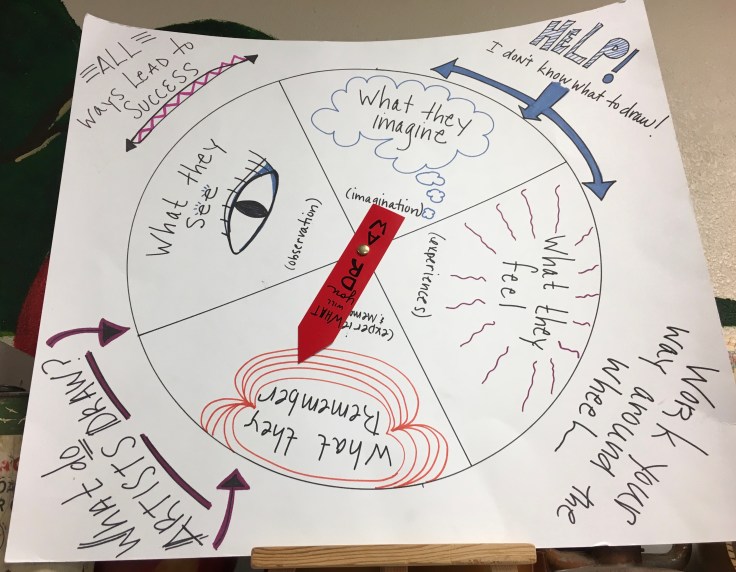
We begin by opening the drawing center, which is always the first media center I open. As students explore the materials and techniques of this center, we discuss the four things artists draw:
- Artists draw with they remember
- Artists draw what they feel
- Artists draw what they imagine
- Artists draw what they see
Next, students divide their paper into four squares and rotate around the room visiting four different tables, each with one of the above prompts. A few friendly constraints help so at the “remember” table I ask students to draw one of their earliest childhood memories. At the “feel” table, the prompt asks students to draw the emotion JOY. For the “imagine” table students are asked to invent something that combines a food with a mode of transportation (think apple-car), and at the “see” table I place a large house plant in the center for students to draw. As students begin to work, I orbit around the room and help them break down the tasks and brainstorm. Stick people and basic drawings are allowed and a timer helps keep the pace energetic and fun.
The next time we meet, students complete a quick worksheet tocheck for understanding. They work with their table mates (think-pair-share style) to identify the four things artist draw and then reflect on their own strengths and weaknesses. Helping them zero in on what their preferences are helps inform their future practice as artists and it helps me guide them.
Many students see art as something that’s only attainable for the “talented” few and this activity is the first step in dispelling that myth. By breaking down the process by which artists generate ideas, students begin to see that process as something they can do and in most cases, as something they are actually already doing.
 The Endless Artroom
Leave a comment